Making Art, Part 4 — October 2026
(Continued from Making Art, Part 3) Covid made my priorities clear: If this was the end of life as I’d known it, I wanted to paint. To spend my last days creating images, images that told a story. And that’s what I did. Every day in my little apartment studio, paper pinned up on the walls, acrylic black and white on the ready, a little red and yellow on the side. I finished the book, a story that was really my story, a narrative about the impact of war and mental illness over three generations.
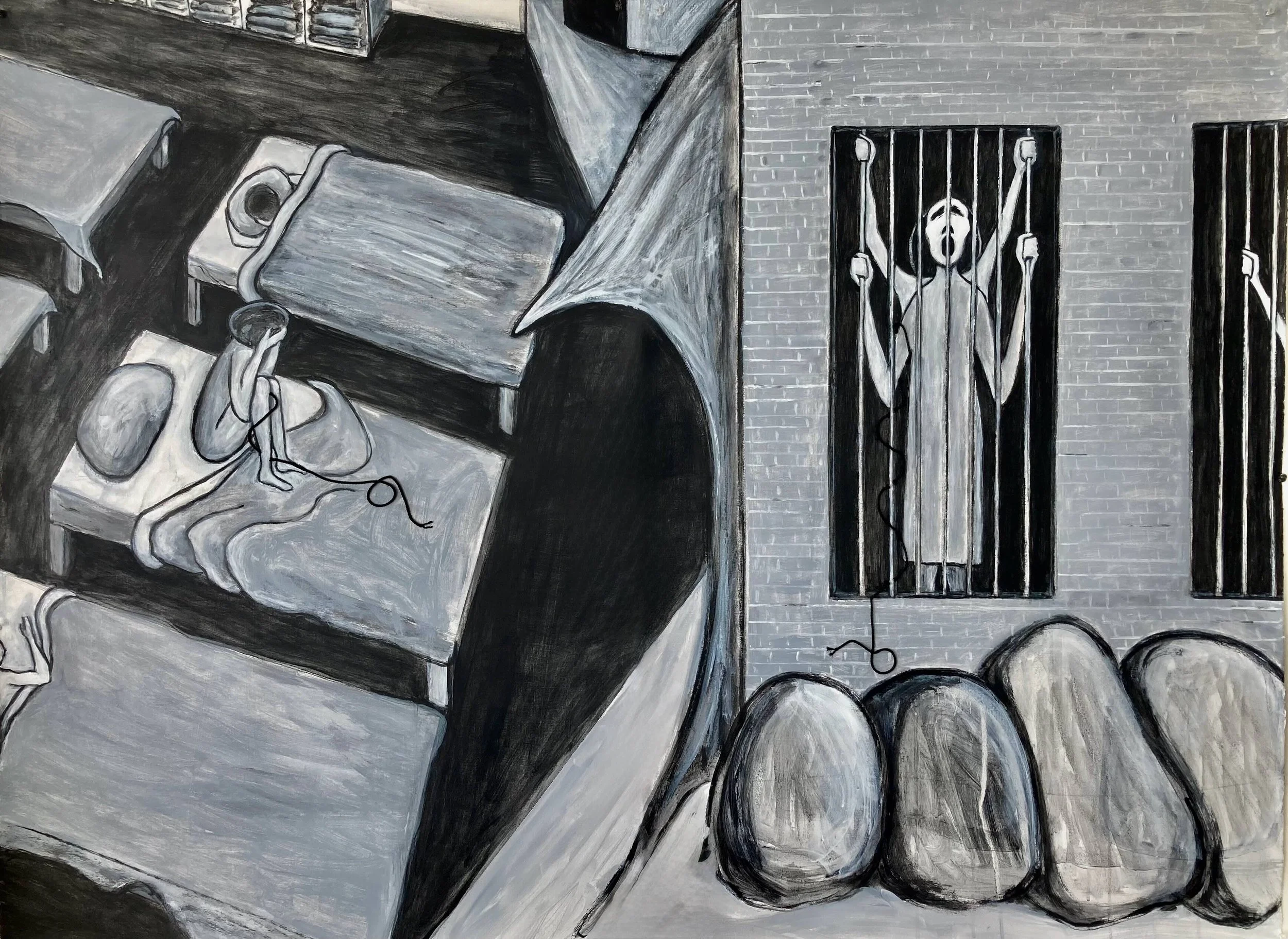
The ideas came. I woke with a picture in mind. One day it was a memory of when I was in a tiny residential school for a couple months or maybe more around age six while my mother was in some mental hospital. I remembered the smell, the feel of the dorm, a few of the other kids, and only later, much later, like when I was fifty something, did I understand it was a form of state foster group home. “Mommy,” I whined into the phone when my mother finally called, back then. “Mommy, when are you coming to get me? I miss you!” I cried. I begged. I cut my hair into bangs. I skipped from first to third grade in the little kitchen schoolroom.
I pictured the painting about that memory as two parts — the dorm with the little kids in their beds and the little girl crying, and the other half — my mother at the barred windows of the State Mental Hospital screaming.
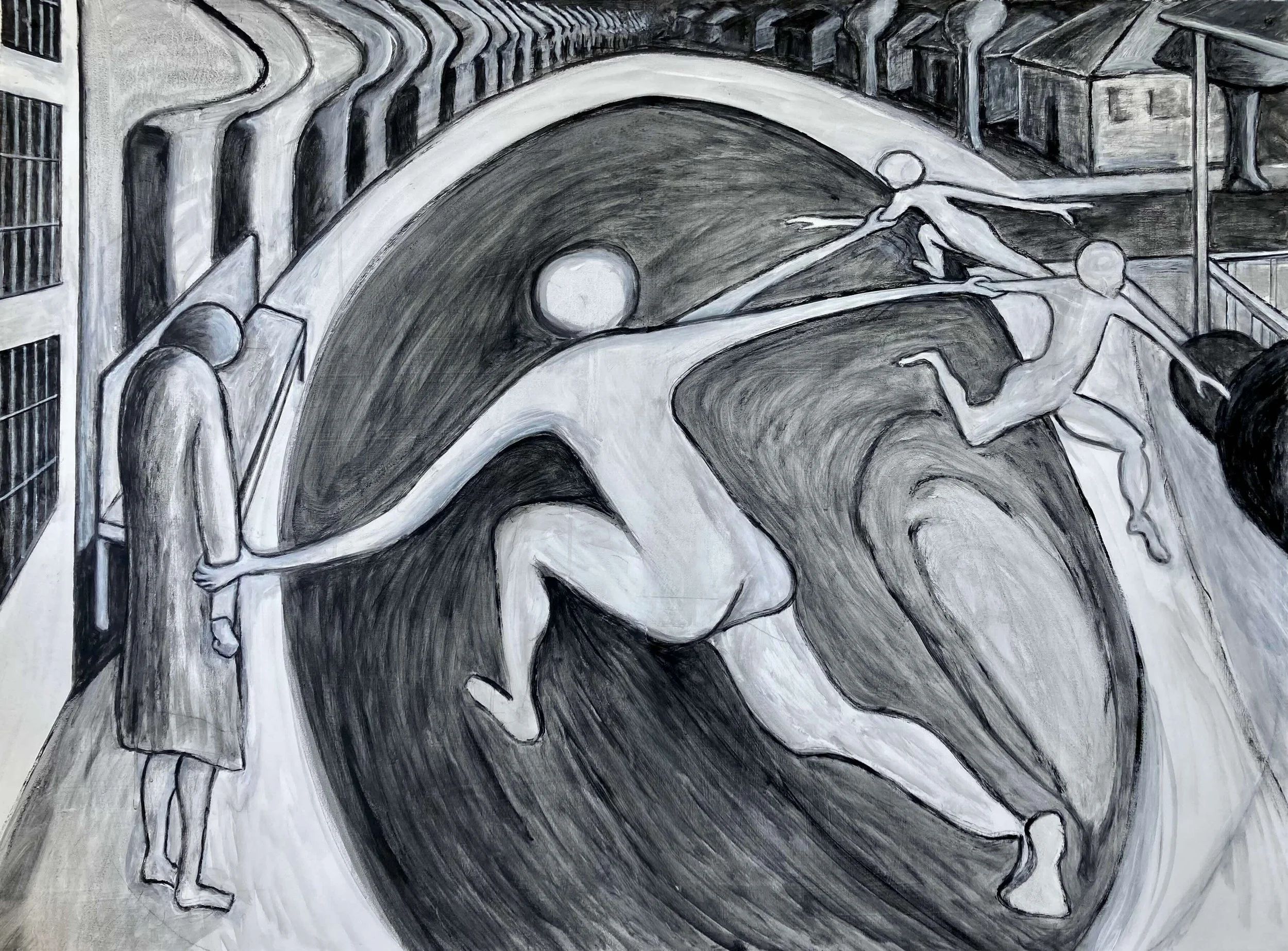
Another image popped into my mind while sketching in the studio. How to suggest that the daughter was caught between mothering and daughtering? A circular tug of war, my two kids and my mom all pulling me round and round between the barred hospital on one side and the family home with my kids on a ‘pleasant’ residential road on the other.
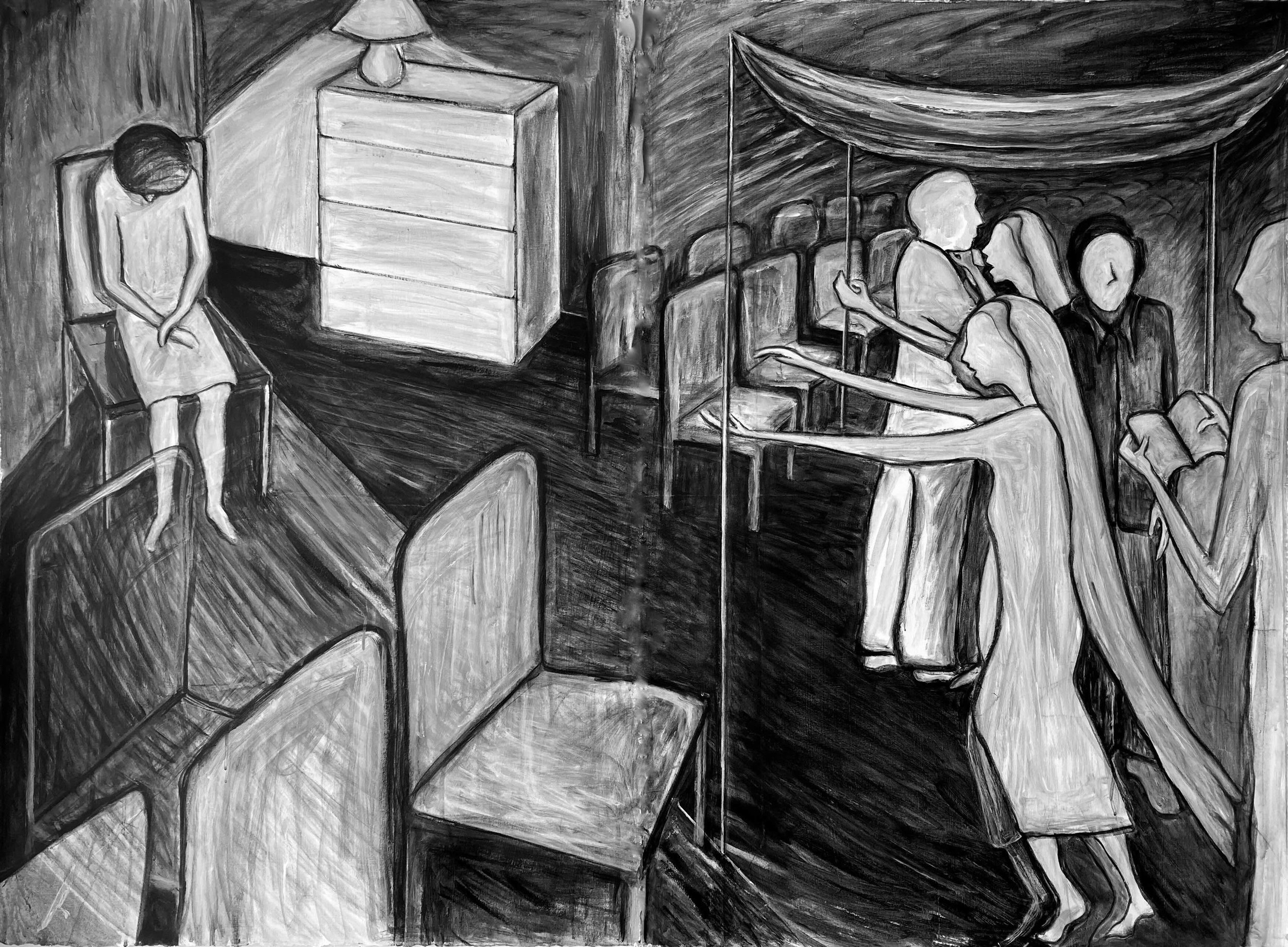
And then the one about the wedding to my first husband when my mom was so wildly crazy that I had to pretend there was no wedding. I couldn’t go forward and have my mom screaming in the room full of guests. I painted myself standing under the Huppah with everyone dancing, including me, but also, I stand separately reaching out to my mother who is seated in a bedroom, looking down at the floor.
Suffering . Suffering expressed visually. Recently I created an Instagram post with that title and mounted detail images of a girl bent over herself at the locked door to a mental ward at the hospital, of a woman curled up in a chair waiting for her lover to return, of a woman curled in the fetal position as a man abandons her out the door. Bang, smash, whish, wail, slam, crash! All the pain. All the hardship. All the crying and the wanting and the longing and the disappointment and the despair.
Can art wash those feelings away down the river of resolution? Can we move from grief, sorrow, panic, to release, to relief, to absolution? Am I free now?
It’s Friday, and I have just received two boxes from UPS. I had mailed them to myself in L.A. after dismantling the old Holyoke warehouse storage area in which I had left my paintings and sculptures over the last few years since I gave up the studio back East. I now lug them up to the apartment on a dolly and open both boxes. One holds a tight roll of four paintings on paper which bounces to life once freed from its rubber bands. A painting of bringing my mother for a haircut years ago and the feeling in my belly as the beautician pointed out a crusty part of my mother’s scalp. What was the experience? Dread? Humiliation? Disgust? I did not, did not want to deal with it… Why was I responsible? What could I do?
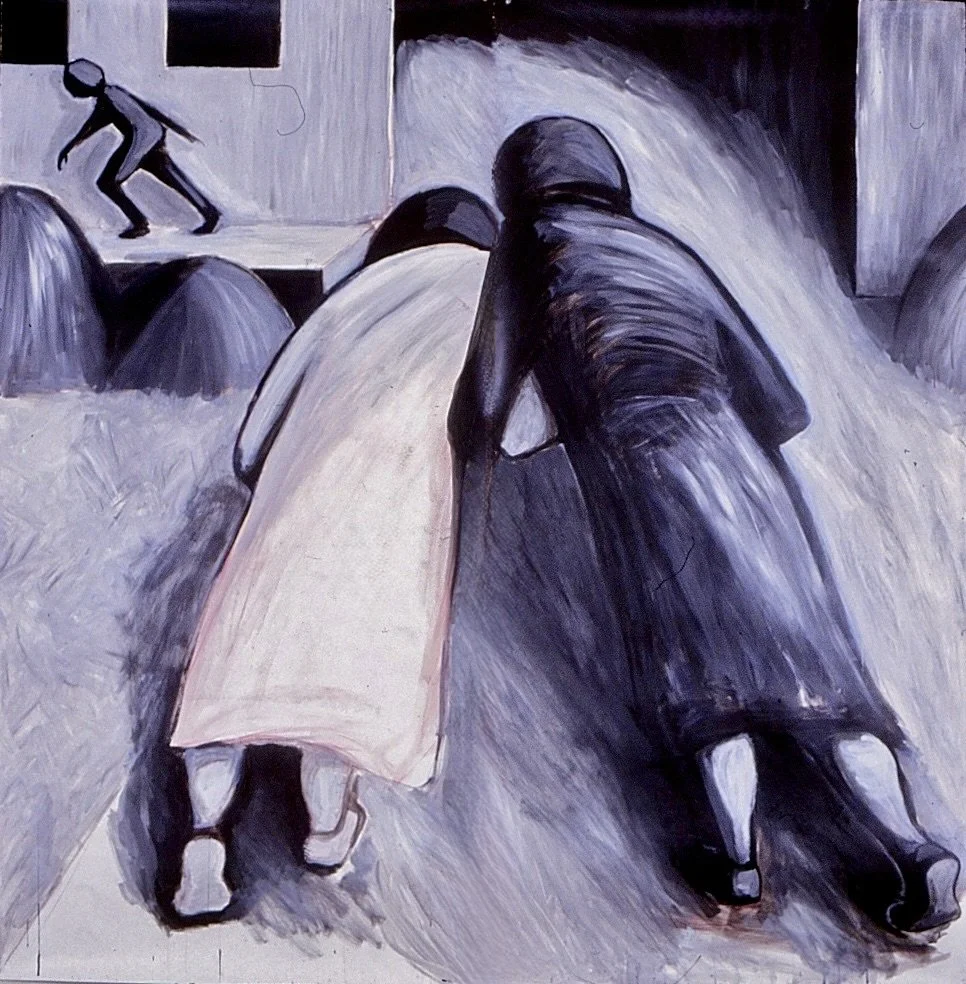
A tantrum kind of painting. Another was of two women walking towards a small ranch house. One, the younger looking, is supporting the other, an older woman. It’s called ‘Guiding Germaine.’
The other box had at least ten flat paintings on paper, many brightly colored, a few black and white. Some were small single paged paintings. But a couple were huge, 88” X 60”. I hung one of those, an image of a woman beseeching another from her bed. It was called, ‘The Demand.” I stood next to the four large sheets of paper and saw that the characters were much larger than I was.
I could barely remember painting this piece. How long ago? I looked at the back of one of the four sheets making up ‘The Demand.’ 1984. Forty years earlier! I would have had my kids already, maybe even my shared huge studio in Holyoke, MA. I had been painting my experiences visiting my mom in a halfway house in Hadley in real time. I would go to the studio and paint whatever floated into my consciousness, the ideas like clouds, they arrived and moved from conception to reality just like that. Did I decide colors first? Shape? Size? So random, it all seemed, and yet I could look at each piece and know, truly know what I had experienced. Depth of feeling. Woe. Intensity. Anguish.
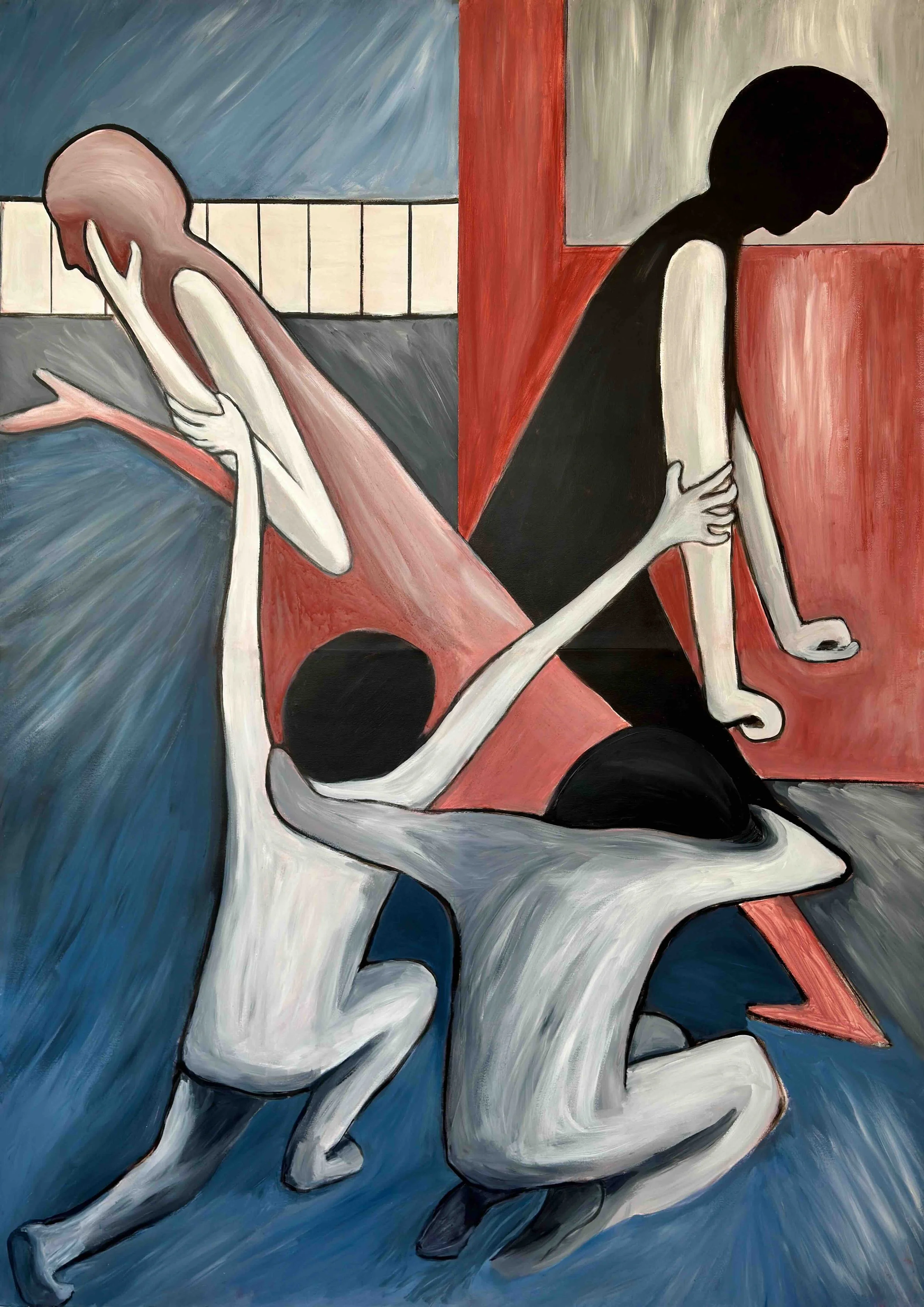
I unpacked the boxes and photographed each piece, tacking them on the wall, learning how to get RAW images at high resolution on my newish iPhone and looked, really looked at the whole of this image and then that one. ‘Dissolution’ — two adults facing away from each other as two children huddle at their feet, pulling them together. “The Demand,’ with a screaming woman stretching her arms toward a person sitting across from her, that person with her/his hands holding her/his head. Wild pain. Wild angst. Wild wildness.
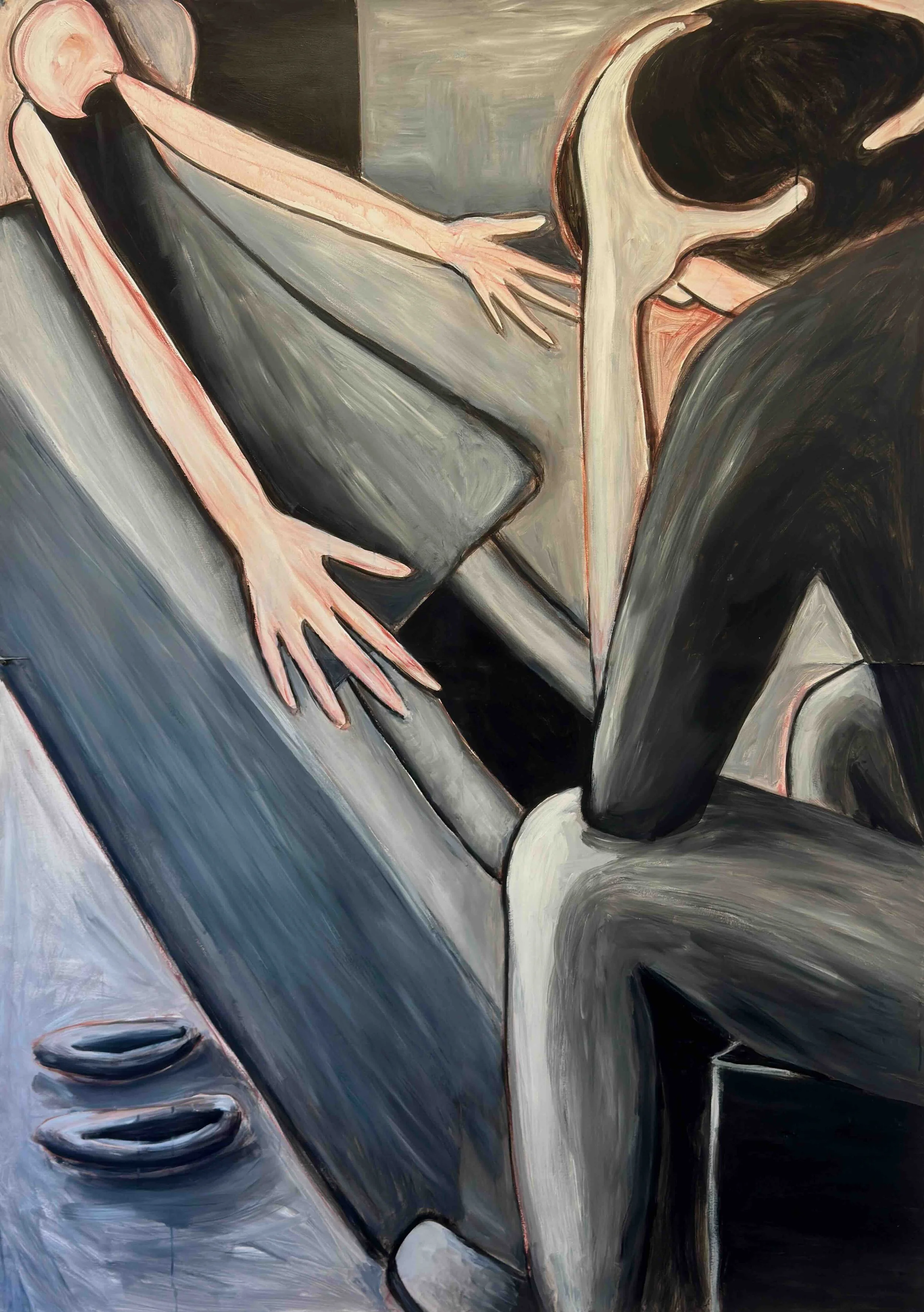
I would have to figure out how to integrate these old pieces into the book… they were different than the ones I had painted since Paris. More colorful, more impressionistic. But their rawness, having been created in the heat of the hard times, spoke loudly. They would find their way into the graphic novel.
For now, I unpinned each piece of the four piece and two-piece paintings from the wall and piled them in between glassine sheets. Then I took two large sheets of cardboard, taped three sides creating a portfolio and leaned it against the wall. I found an old cardboard box from a recent shipment of paper and stuffed the portfolio into it, leaving one end open to accommodate the paintings that extended over its lip, too long for a perfect fit.
Tomorrow I would bring up a rolling cart and put the heavy box onto it and bring it down to the elevator and to the art storage unit in the basement.
And then? And then? What then?
I sat down on the couch in the living room and stared out the window at the big big ocean. It was that time of day when the sun hit the water just so, bounding up in a magical sparkle. Like diamonds. No, like a panel of mirrors reflecting the celestial infinite space. Blinding.
It was blinding to consider the now. It was open. So much to say. So much needing to be said. I watched a flock of gulls sweep across the horizon. In unison. Like the Rockettes. Like synchronized dancers. I watched them as they disappeared out of my view. I could only see so far.
What I hoped was for the graphic novel to be published. To have it read and felt by others facing their own adversity. I wanted them to know that things keep changing, that what feels impossible can transform into a kind of beauty over time, that art can be part of the magic. For both the artist and the observer. There are stories that want to be told and want to be heard. I hoped mine would join the many that already have had an impact, that have made a difference. I was making art, telling my tale. That was the best I could do.